DC Flight Restricted Zone
Start with the exact location. Commercial certification alone is not an airspace authorization, and no flight is confirmed before feasibility and required approvals are reviewed.
Drone by Dro has completed many DC FRZ jobs, including in Silver Spring, College Park, Bethesda, Potomac, Takoma Park and Washington, DC. Every new location is still reviewed on its own, and approval is not guaranteed.
01 / Understand the airspace
FRZ, SFRA & the outer ring
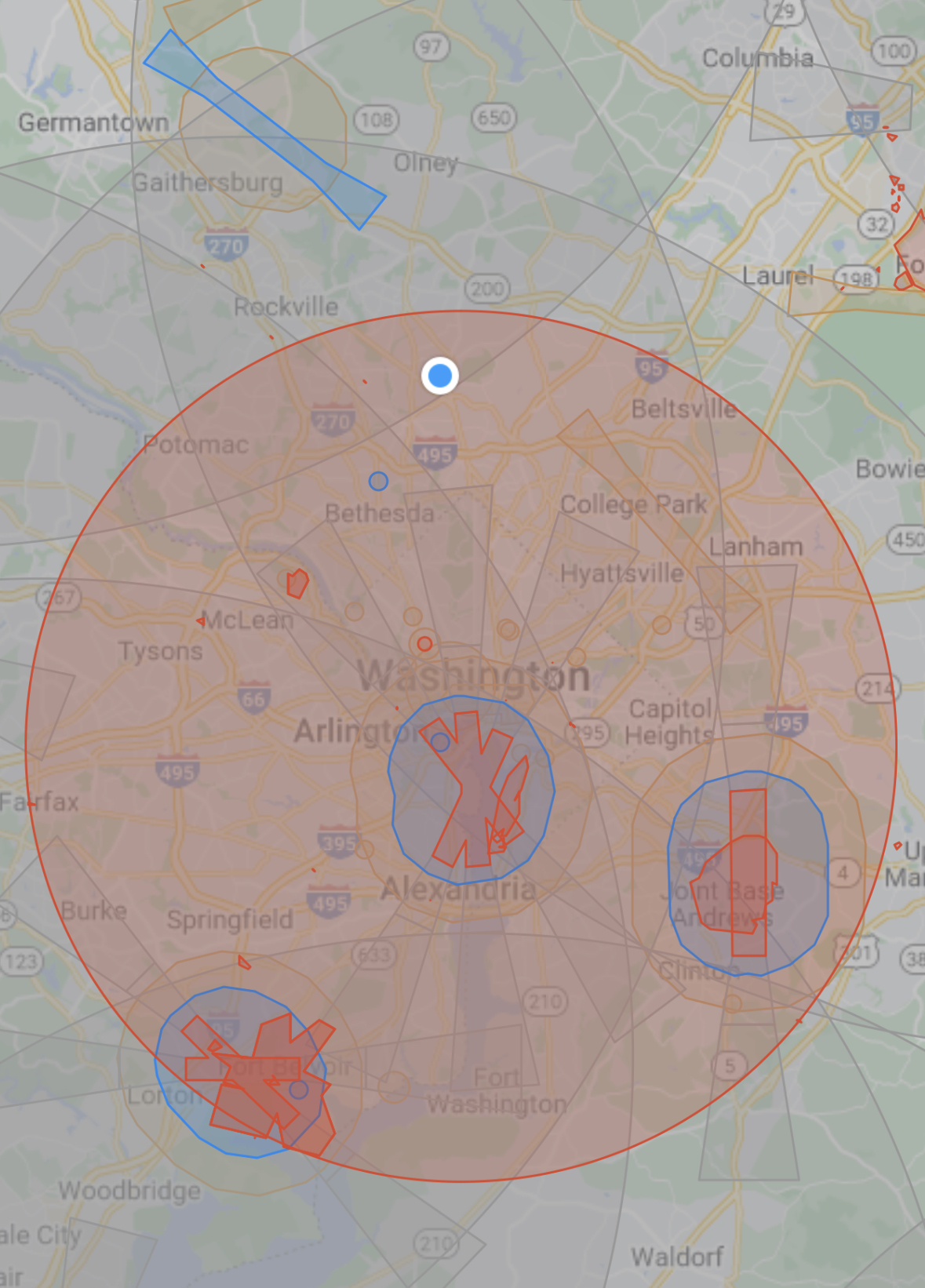
The FRZ is the sensitive inner portion of the Washington, DC Special Flight Rules Area (SFRA). The SFRA extends roughly 30 nautical miles around the DCA VOR/DME; the FRZ is roughly 15 NM, but its actual boundaries are not a perfect circle. The applicable CFR and current NOTAMs control, not a radius estimate.
Commercial work in the outer SFRA must comply with Part 107 and all other applicable airspace approvals and restrictions. Recreational operations have distinct requirements. Being outside the FRZ does not automatically authorize a flight.
P-56A and P-56B are prohibited areas with special restrictions. Do not assume a commercial airspace waiver allows operations there. The exact site and operative restrictions must be reviewed before flight can be considered.
No. LAANC handles eligible controlled-airspace authorizations. It does not provide blanket permission for the FRZ, P-56, security restrictions or temporary flight restrictions (TFRs).
Is my location in the FRZ?
Use official FAA mapping and current NOTAMs, then request an address-specific review. This diagram is not a navigation tool or legal determination.
02 / Mission-specific review
From brief to capture
01
Brief & location
Exact site boundaries, purpose and date window define the request.
02
Feasibility
Review operative restrictions, mission justification and site requirements; not every request is eligible.
03
Documents & coordination
Coordinate the applicable TSA/FAA airspace waiver and FAA SGI/COA process.
04
Approval conditions
Proceed only under issued conditions and current restrictions; approval is not guaranteed.
05
Capture
Confirm property access, permissions, safety and the authorized scope before capture.
The operator coordinates the applicable mission-specific TSA/FAA airspace waiver and FAA SGI/COA process. Review is case by case. TSA guidance requires a compelling need; purely promotional scenic views, sightlines or virtual tours are not routinely authorized. Additional scrutiny applies near sensitive locations, including within seven NM of DCA.
03 / Prepare your inquiry
A useful client checklist
- Exact address and site boundaries
- Date window and flexibility
- Mission purpose and why this location is needed
- Shot and altitude needs
- Property contact and permission status
- Site access, safety and parking details
DC FRZ inquiry
Describe your mission for location review. This opens an email draft; review and send in your email app. No approval is granted by submitting an inquiry.
04 / Common planning questions
DC FRZ questions, answered
What is the DC Flight Restricted Zone?
The FRZ is the sensitive inner portion of the Washington, DC Special Flight Rules Area (SFRA). The SFRA extends roughly 30 nautical miles around the DCA VOR/DME; the FRZ is roughly 15 NM, but its actual boundaries are not a perfect circle. The applicable CFR and current NOTAMs control, not a radius estimate.
Can a Part 107 pilot fly in the 15–30 NM ring?
Commercial work in the outer SFRA must comply with Part 107 and all other applicable airspace approvals and restrictions. Recreational operations have distinct requirements. Being outside the FRZ does not automatically authorize a flight.
Does LAANC authorize FRZ flights?
No. LAANC handles eligible controlled-airspace authorizations. It does not provide blanket permission for the FRZ, P-56, security restrictions or temporary flight restrictions (TFRs).
What about P-56A and P-56B?
P-56A and P-56B are prohibited areas with special restrictions. Do not assume a commercial airspace waiver allows operations there. The exact site and operative restrictions must be reviewed before flight can be considered.
Who applies, and is every commercial request eligible?
The operator coordinates the applicable mission-specific TSA/FAA airspace waiver and FAA SGI/COA process. Review is case by case. TSA guidance requires a compelling need; purely promotional scenic views, sightlines or virtual tours are not routinely authorized. Additional scrutiny applies near sensitive locations, including within seven NM of DCA.
Is approval guaranteed, and how long should we plan?
Approval is not guaranteed. Drone by Dro has published a typical-in-our-experience estimate of 2–4 weeks, not an official duration or current promise. TSA’s June 27, 2024 guidance says to allow at least 15 working days after a complete application, with additional information potentially extending review. Timing and conditions vary; contact us early and check current guidance.
What information should I provide?
Provide the exact address and site boundaries, date window, mission purpose, requested shots and altitude needs, property contact, and site access or safety details. The location must be reviewed before any flight is confirmed.
Are indoor-only drone flights different?
FAA rules for outdoor operations in the National Airspace System do not apply to completely indoor operations. Venue permission, safety and insurance considerations still apply. Any outdoor segment changes the airspace review.
Does airspace approval replace property permission or filming permits?
No. Property access, local filming permits and other site requirements are separate from FAA/TSA authorization. Confirm each applicable requirement for the assignment.
Can a small drone fly over people?
Weight alone is not permission. FAA Category 1 requires 0.55 lb or less including payload throughout flight and no exposed rotating parts capable of laceration. Sustained flight over open-air assemblies requires Remote ID compliance. All other applicable Part 107 and airspace requirements remain; aircraft and mission eligibility must be assessed.
Official sources
Last reviewed November 7, 2026 (ET)
General planning information, not flight authorization. Check official current rules, NOTAMs and any issued approval conditions before an operation. The 2024 TSA document supplies review-planning guidance, not a promise of eligibility or timing.
Airspace permission does not replace property permission or local permits.